
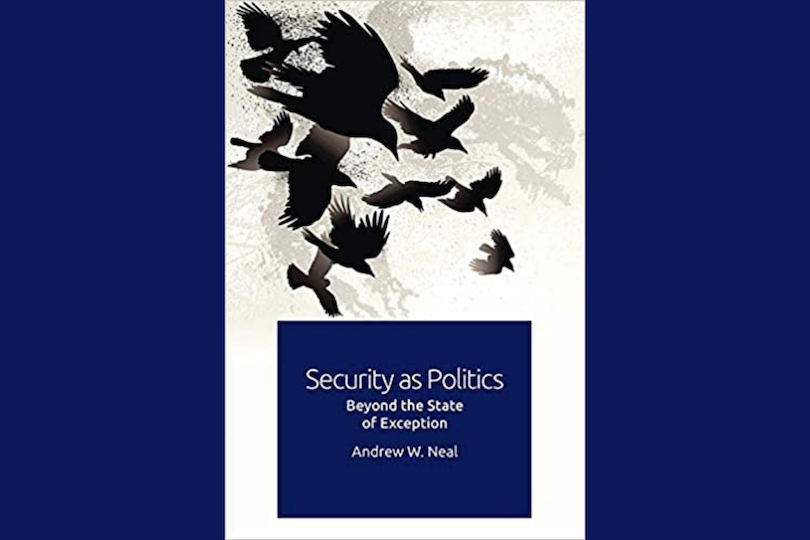
Security as Politics: Beyond the State of Exception
By Andrew W. Neal
Edinburgh College Press, 2019
Andrew Neal’s thought-provoking e-book explicates the connection between safety and politics by demonstrating that the altering pursuit and follow of safety has turn out to be a definite a part of skilled politics. It focuses on the latest transformation of safety practices, presents a classy prognosis of the reigning view of safety as ‘anti-politics’ as an outmoded conceptualization of a specific time and place (round mid-Nineties), after which empirically examines the principles of the sport within the new safety politics of our instances. The e-book is a crucial contribution to the crucial safety research scholarship each in its theoretical innovation and empirical rigor. It succeeds in taking crucial safety research to job, however the e-book can also be a conversation-opener on new safety governance. Regardless of some points that reasonable its revolutionary thrust, Safety as Politics is an excellent e-book.
Chapter Two focuses totally on an acceptable analysis technique for the evaluation of recent safety governance. The strategy Neal presents is problematisation, which rests on 4 pillars: empiricism, historic inquiry, reflexivity, and critique. It’s empiricist within the sense of asking us to concentrate on what actors say and do once they have interaction in safety, and it’s historic as a result of distinct safety problematisations are particular to time and place, which should be excavated reasonably than fixated by trans-historical definitions and logics. This historic empiricism focuses on detailed practices and causes of interlocutors. Nevertheless, it doesn’t require us to show into historians to solely rethink the previous. As an alternative, within the spirit of Foucault, we learn the previous to “put our current considerations in a brand new gentle” (p.57). Such a transfer additionally requires a reflective position of the analysts from their completely different “vantage factors” (p.55) reasonably than by a strict reliance on the self-understanding of securitizing actors alone. The reflexive position of the analyst is an thrilling ongoing dialog within the IR methodology debate (Sundaram and Thakur 2019). Lastly, problematising is a crucial engagement the place an analyst isn’t a disinterested chronicler however amplifies political assumptions of the current. In providing this technique, Neal departs from the worn-out governmentality strategy and thoroughly takes us to Foucault’s different attention-grabbing concepts on the political. This is a crucial chapter that each safety research pupil should learn.
Chapter Three engages with the specialised literature on securitization and politicisation to conceptualize safety as regular politics. That is essential as a result of the principled and normative concentrate on “the political” in crucial safety research got here with an air of disenchantment in the direction of the follow of safety at larger institutional places similar to the chief. Such a view is outdated in right this moment’s world as safety practices has migrated from the black field of govt. Neal presents a conceptualization of “enviornment migration” to grasp the motion of safety points between these completely different places (p.103).
Clearly, Neal’s conceptual structure in revolutionary. But, there are two points that run by Chapters One and Three. First, one needs that Neal spent extra time discussing how the contingency {of professional} parliamentary politics suits into this bigger concept of regular politics. Neal foregrounds an essential however much less identified Machiavellian concept that ordinary politics should be understood as contingent vicissitudes of fortuna. Hecreatively appropriates it for our instances as politicians pursue such politics of fortuna to save lots of their parliamentary seat/place (pp.19-23). Maybe saving a parliamentary seat as regular politics may apply to Britain, the place ministers rating extremely on integrity of public life (Thomas 2020). Though, in recent times, the skilled political actions of British parliamentarians aren’t regular, to say the least (Taylor 2016). Nevertheless, in lots of different elements of the world, skilled parliamentary/congressional politics to save lots of seats are vile and deadly. Such performances have remodeled regular politics, if we contemplate “regular” to imply an ethic of accountability and obligation of answerability taking precedence by giving and taking causes amongst interlocutors on safety points. For instance, some politicians have interaction in so-called regular politics to defend criminals (Patel 2019), others acceptable overseas and safety points utilizing pork barrel initiatives (Heinrich and Peterson 2020) and senators have interaction in unruly and corrupt monetary practices utilizing nationwide safety discourse (Goldstein 2018). Neal doesn’t undermine or ignore these issues in skilled politics. It might need been good to see some extra discussions on the transformation of the political even when safety can now not be outlined as anti-politics.
The second subject is whether or not one may keep away from any normative place in any respect in the direction of “regular politics.” Neal accepts most of the ongoing critiques of regular politics, but he maintains an analytical versus normative distinction all through the e-book (p.10). Within the conclusion Neal may have articulated his principled critique both on the constructive or adverse results of the politics of safety; as a substitute, we see a stoic view within the deployment of assessments similar to “rightly or wrongly”, for “higher or worse”, safety is a part of regular politics even when outdated safety politics retain its maintain. Absolutely such consistency is essential to redress the issues of crucial safety research. But, in recent times the political isn’t solely about inventive drawback fixing by professionals within the public sphere anymore, it’s also about, as Bernard Harcourt places it, “What am I to do?” (Harcourt 2020).
Chapters 4 by Seven are glorious empirical research on the political recreation of safety. Given the massive canvas, he focuses on the infamous UK case, which is a “cockpit of safety innovation, exporting its fashions and strategies globally” (p.29). Neal is true in arguing that the which means and follow of safety have expanded to new points – power, well being, or cyber – which have additionally seen a better involvement {of professional} British politicians in these arenas thereby difficult govt dominance because the unstated “guidelines of the sport”. By Bourdieu’s impressed sociological concentrate on practices, Neal exhibits that parliamentarians themselves up to now had deferred to govt dominance on safety as “institutionalized frequent sense” (p.135) however are actually altering their habitus. This permits Neal thus far institutionalized securitization within the UK to the world of govt prerogative to the Nineteen Eighties and present how the ‘guidelines of the sport’ of British parliamentary safety politics modified with better involvement of those actors in safety points.
Taking the resignation of Conservative MP David Davis over the encroachment of civil liberties within the 2008 Counter-Terrorism invoice as a foil, Chapter 5 explains how people problem the principles of the sport. It has a pathbreaking dialogue taking a look at Davis’ act by Foucault’s work on parresia – fact telling – and never as skilful rhetoric to merely persuade audiences. Neal’s concentrate on parresia exhibits how actors “problematise wider societal and political constructions of inclusion, exclusion and energy” (p.179). Such an excellent systematization of Foucault’s emphasis on articulating brave fact towards congealed discursive constructions must also put to relaxation the inaccurate however standard view on Foucault’s position in post-truth tradition (Andersen 2017). Chapter Six examines the rise in parliamentary committee exercise on safety and Chapter Seven examines UK governmental exercise on safety from the angle of danger.
The e-book ends with an attention-grabbing dialogue of whether or not extra political exercise makes us roughly safe. Neal’s dialogue is nuanced, specializing in parliament as a website that’s each for and towards safety. Consequently, the e-book rightly means that skilled politicians’ energetic engagement with safety doesn’t imply we witness some progress (teleological or in any other case) or that normalisation of safety is full (p.281). No less than in Western liberal democracies, we see that new safety governance can operate with out securitization or exceptionalism. I consider it hints at a way more harmful portent of safety governance inside the institutional guidelines of the sport. It’s a dialog opener for inspecting safety practices within the non-Western world. In India, parliamentary politics is definitely essential. It was central within the Bharatiya Janata Celebration (BJP) authorities “One Nation” mission and paradoxically to rising intolerance to variety. So Prime Minister Narendra Modi desires a $1.8 billion parliamentary constructing (Hollingsworth and Gupta 2021), categorises the mission as an “important service” regardless of lack of oxygen for Covid-19 sufferers, and enthusiastic Indian MPs – a few of them with felony information – can’t wait to debate geopolitics and safety points to redeem India’s greatness (See Vaishnav 2017). Accordingly, on the subject of the non-Western world in recent times, safety is politics but skilled politics on safety can also be meanspirited and terribly harmful. Neal’s e-book is essential to look at this interconnection in new methods.
References
Andersen, Kurt. 2017. “How America Misplaced Its Thoughts” The Atlantic 28 December. https://www.theatlantic.com/magazine/archive/2017/09/how-america-lost-its-mind/534231/
Goldstein, Donna M. 2018. “Already Harmless: Radioactive Bribes, White-Collar Corruption and Nuclear Experience in Brazil.” Tradition, Concept and Critique 59 (4): 354–79.
Harcourt, Bernard. 2020. Critique and Praxis (Columbia College Press)
Patel, Anand. 2019. “Practically 50 per cent MPs in new Lok Sabha have felony information,” India Right now 25 Might. https://www.indiatoday.in/elections/lok-sabha-2019/story/50-per-cent-mps-new-lok-sabha-criminal-records-1534465-2019-05-25
Sundaram, Sasikumar, and Vineet Thakur. 2019. “A Pragmatic Methodology for Finding out Worldwide Practices.” Journal of Worldwide Political Concept.
Tobias Heinrich and Timothy M. Peterson, 2020. “Overseas Coverage as Pork-barrel Spending: Incentives for Legislator Credit score Claiming on Overseas Support” Journal of Battle Decision
Taylor, Adam, 2016. “The Petty, imply, and deliciously impolite methods British politicians insult each other,” The Washington Put up, 25 February 2016. https://www.washingtonpost.com/news/worldviews/wp/2016/02/25/the-petty-mean-and-deliciously-rude-ways-british-politicians-insult-one-another/
Thomas, Alex 2020. “Integrity is meant to maintain British ministers in line. It’s clearly not sufficient”, The Guardian, 21 November. https://www.theguardian.com/commentisfree/2020/nov/21/integrity-ministers-bullying-covid-contracts
Vaishnav, Milan. 2017. When Crime Pays: Cash and Muscle in Indian Politics (Yale College Press).