

Fluency —
And it’s moreover elevating questions on innate grammar.
Morten Christiansen and Pablo Contreras Kallens, The Dialog –

Increase / Resides in a language-prosperous world ample to coach a restricted bit of 1 grammatical language?
No longer just like the fastidiously scripted dialogue show in most books and movies, the language of day by day interaction tends to be messy and incomplete, rotund of fallacious begins, interruptions, and of us talking over each different. From informal conversations between friends, to bickering between siblings, to formal discussions in a boardroom, official dialog is chaotic. It seems to be miraculous that any particular person can study language in any recognize given the haphazard nature of the linguistic expertise.
For this motive, many language scientists—together with Noam Chomsky, a founding father of normal linguistics—deem that language newbies require a further or a lot much less glue to rein within the unruly nature of day by day language. And that glue is grammar: a machine of rules for producing grammatical sentences.
Kids should personal a grammar template wired into their brains to assist them overcome the constraints of their language expertise—or so the pondering goes.
This template, as an example, would possibly per likelihood maintain a “elegant-rule” that dictates how current objects are added to current phrases. Kids then best need to study whether or not their native language is one, take pleasure in English, the construct the verb goes prior to the merchandise (as in “I recognize sushi”), or one take pleasure in Japanese, the construct the verb goes after the merchandise (in Japanese, the similar sentence is structured as “I sushi recognize”).
However current insights into language discovering out are coming from an now not seemingly supply: artificial intelligence. A current breed of stylish AI language devices can write newspaper articles, poetry, and pc code and reply questions actually after being uncovered to gracious quantities of language enter. And even further astonishingly, all of them fabricate it with out the assist of grammar.
Grammatical language with out a grammar
Regardless of the reality that their chance of phrases is usually extraordinary, nonsensical, or comprises racist, sexist, and different immoral biases, one factor is extremely clear: The overwhelming majority of the output of these AI language devices is grammatically beautiful. And however, there are not any grammar templates or rules hardwired into them—they depend upon linguistic expertise on my own, messy as it could possibly per likelihood presumably be.
GPT-3, arguably essentially the most famed of these devices, is a mammoth deep-finding out neural neighborhood with 175 billion parameters. It was educated to foretell the following observe in a sentence given what got here prior to throughout a total lot of billions of phrases from the Web, books, and Wikipedia. When it made a fallacious prediction, its parameters personal been adjusted the make the most of of an automated discovering out algorithm.
Remarkably, GPT-3 can generate plausible textual comment reacting to prompts equal to “A abstract of the ultimate Fleet and Livid film is…” or “Write a poem within the type of Emily Dickinson.” Moreover, GPT-3 can reply to SAT-level analogies, discovering out comprehension questions, and even resolve straight ahead arithmetic problems—all from discovering out how one can predict the following observe.
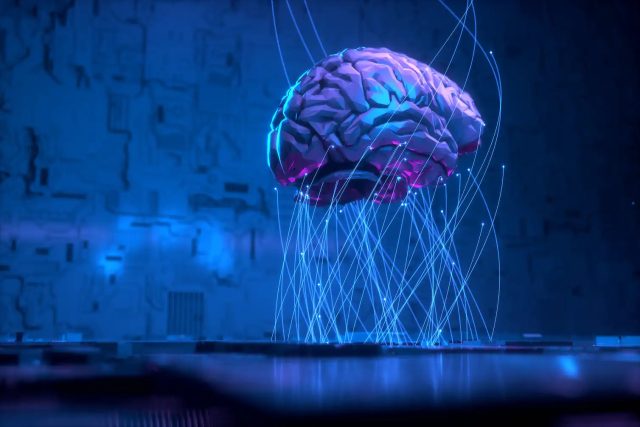
Increase / An AI mannequin and a human mind may generate the similar language, nonetheless are they doing it the similar approach?
Just_Super/E+ by process of Getty
Evaluating AI devices and human brains
The similarity with human language doesn’t conclude right here, nonetheless. Examine printed in Nature Neuroscience demonstrated that these artificial deep-finding out networks seem to make the most of the similar computational options because the human mind. The consider personnel, led by neuroscientist Uri Hasson, first when put subsequent how nicely GPT-2—a “restricted brother” of GPT-3—and folk would possibly per likelihood predict the following observe in a story taken from the podcast “This American Life”: Of us and the AI predicted the precise similar observe practically about 50 p.c of the time.
The researchers recorded volunteers’ mind process whereas taking place of the story. The best motive within the assist of the patterns of activation they observed was that folks’s brains—take pleasure in GPT-2—weren’t beautiful the make the most of of the previous one or two phrases when making predictions nonetheless relied on the gathered context of as so much as 100 earlier phrases. Altogether, the authors waste: “Our discovering of spontaneous predictive neural indicators as members hear to pure speech means that lively prediction may underlie of us’ lifelong language discovering out.”
A possible say is that these current AI language devices are fed moderately just some enter: GPT-3 was educated on linguistic expertise similar to twenty,000 human years. However a preliminary peek that has now not however been sight-reviewed discovered that GPT-2 can restful mannequin human subsequent-observe predictions and mind activations even when educated on beautiful 100 million phrases. That’s nicely inside the amount of linguistic enter {that a} median restricted one would possibly per likelihood hear everywhere in the first 10 years of existence.
We’re now not suggesting that GPT-3 or GPT-2 study language exactly take pleasure in youthful of us fabricate. Definitely, these AI devices fabricate now not seem to salvage so much, if one thing else, of what they’re asserting, whereas understanding is key to human language make the most of. Nonetheless, what these devices show is {that a} learner—albeit a silicon one—can study language nicely ample from mere publicity to supply completely appropriate grammatical sentences and fabricate so in a way that resembles human mind processing.

Increase / Further back and forth yields further language discovering out.
Rethinking language discovering out
For years, many linguists personal believed that discovering out language is now not seemingly with out a built-in grammar template. The current AI devices show in another case. They painting that the potential to supply grammatical language would possibly be realized from linguistic expertise on my own. Likewise, we counsel that youthful of us fabricate now not want an innate grammar to study language.
“Kids needs to be seen, now not heard” goes the extinct asserting, nonetheless essentially the most normal AI language devices counsel that nothing shall be further from the reality. As a substitute, youthful of us should restful be engaged within the support-and-forth of dialog as so much as seemingly to assist them assemble their language skills. Linguistic expertise—now not grammar—is vital to turning into a reliable language consumer.
Morten H. Christiansen is professor of psychology at Cornell Faculty, and Pablo Contreras Kallens is a Ph.D. pupil in psychology at Cornell Faculty.
This textual content is republished from The Dialog beneath a Inventive Commons license. Learn the genuine article.