

Survival options —
Flip the day sooner than nowadays’s company pc into nowadays’s Pi-admire association—with some work.
Kevin Purdy –
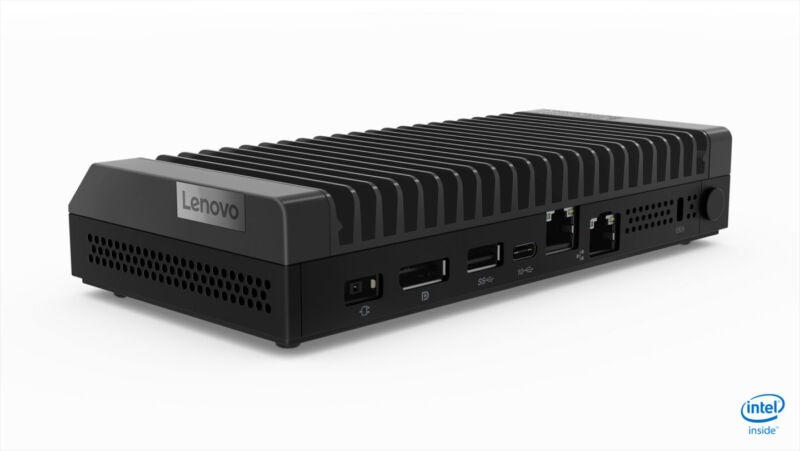
Lengthen / This ThinkCentre M90n-1 Nano from 2019, passively cooled with an enormous heatsink, develop into $145 when the creator closing regarded on eBay. Or not it’s not a Raspberry Pi, and it seems to be admire Batman’s reception desk association, nevertheless it should attain the work.
“Raspberry Pi boards are laborious to uncover, doubtlessly moreover subsequent 12 months,” says Andreas Spiess, single-board fanatic and YouTuber, in his distinctive Swiss accent. He is not unsuitable. Spiess says he and his fellow Pi devotees want “a solution to outlive” with out latest boards, so he suggests wanting in a single of the least thrilling, most overpassed areas of computing: outdated development, corporate-minded skinny consumer PCs.
Andreas Spiess’ advice to “survive” the Raspberry Pi scarcity: low-cost skinny purchasers.
Spiess’ Pi replacements, urged and delicate by lots of his YouTube commenters and Patreon subscribers, are Fujitsu Futros, Lenovo ThinkCentres, and different dinky applications (some or all of which can perchance effectively perchance be semantically considered as “thick purchasers” or merely “mini PCs,” reckoning in your tastes and retro-grouch sensibilities). They’re the roughly applications that you could be with out issues receive outdated development on eBay, refurbished on Amazon Renewed, or via different problem and IT asset disposition sources. They’re on the whole in right kind, given their use and environment. And in distinction to single-board fanatic applications, many extra are being made and changed yearly.
They’ve repeatedly been there, for positive, nevertheless it makes extra sense to uncover one different be taught about at them now. “Attend to the lengthy mosey,” as Spiess places it (in an analogy we’re not absolutely apparent works).
Spiess’ whisk for make-attain Pi servers strikes him earlier latest NUCs on the spot, as they’re too costly and overpowered for Residence Assistant, PiHole, and even a multi-container association. He seems to be at two types of skinny purchasers that work. For a single-cause Pi substitute, practically any Intel or AMD processor works, and likewise you’ll want 4GB of reminiscence and 8GB of solid-notify storage. To mosey a couple of Pi-scale initiatives off one field, Spiess suggests trying to acquire a more moderen processor, 8GB of reminiscence, and a 64GB or 128GB SSD (or individually upgrading both of those if possible). For his single-cause initiatives, he got here throughout a 34-euro Futro ($35 USD) with an AMD GX-222GC SoC; for a couple of containers, he obtained fourth-period i5 and i7 ThinkCentres for 79 and 105 euros ($82 and $109 for the time being).
Then there may be the utility. Putting in Residence Assistant or similar Pi-centered photos on the decrease-powered consumer requires a USB-to-mSATA adapter or booting a Debian association off a dwell USB after which flashing the inner SSD with the picture. For a multi-VM or multi-container machine, Spiess makes use of Proxmox. He installs Residence Assistant in a single digital machine, then IoT Stack on an AMD-64 mannequin of Debian in a single different.
Or not it’s not a revelation {that a} extra extremely environment friendly pc can replicate the job of a a lot less-highly environment friendly pc, nevertheless the delta in vitality consumption and processing could perchance effectively shock some. When in distinction to a Raspberry Pi, Spiess’ extra cheap Fujitsu is typically a piece slower at ESPhome compiling than a Raspberry Pi 4, nevertheless the i5 and i7 had been higher than three situations quicker.
The usage of a meter, Spiess measured their vitality consumption. Two Raspberry Pi gadgets consumed 12 Watts at a largely indolent notify, the Fujitsu at 14 W and the i5 and i7 at 16–18 W (with spikes as a lot as 25 W in some unspecified time in the way forward for excessive train). Looking for skinny purchasers with more moderen processors and higher vitality effectivity would lower these numbers extra, nevertheless Spiess’ scratch math suggests a financial savings of handiest about 24 euros ($25 USD) per 12 months, in distinction to the a whole bunch of bucks extra they value to seize.
Or not it’s clearly extra work to acquire the precise stability of value and dimension within the outdated development skinny consumer (or generally “mini PC”) market and extra work to uncover one working initiatives on the whole meant for the distinctive Pi platform. However bolstering {the marketplace} for second-hand computer systems is a rep right, particularly if a machine nice for tinkering or home automation ends up on your neighborhood closet as an alternative of the shredder. (A tip of the hat to Hackaday for the video hyperlink).